
On my latest visit to Museum Centre Vapriikki in Tampere, I climbed to the second floor for the radio exhibition Riding the radio waves – From crystal radios to podcasts, then wandered straight into the Finnish Museum of Games. Two rooms, one story: how Finns have listened, tinkered and played – from a volunteer radio station by the rapids to Moomin games on a home computer.
Tampere among the first: Finland’s first public radio station
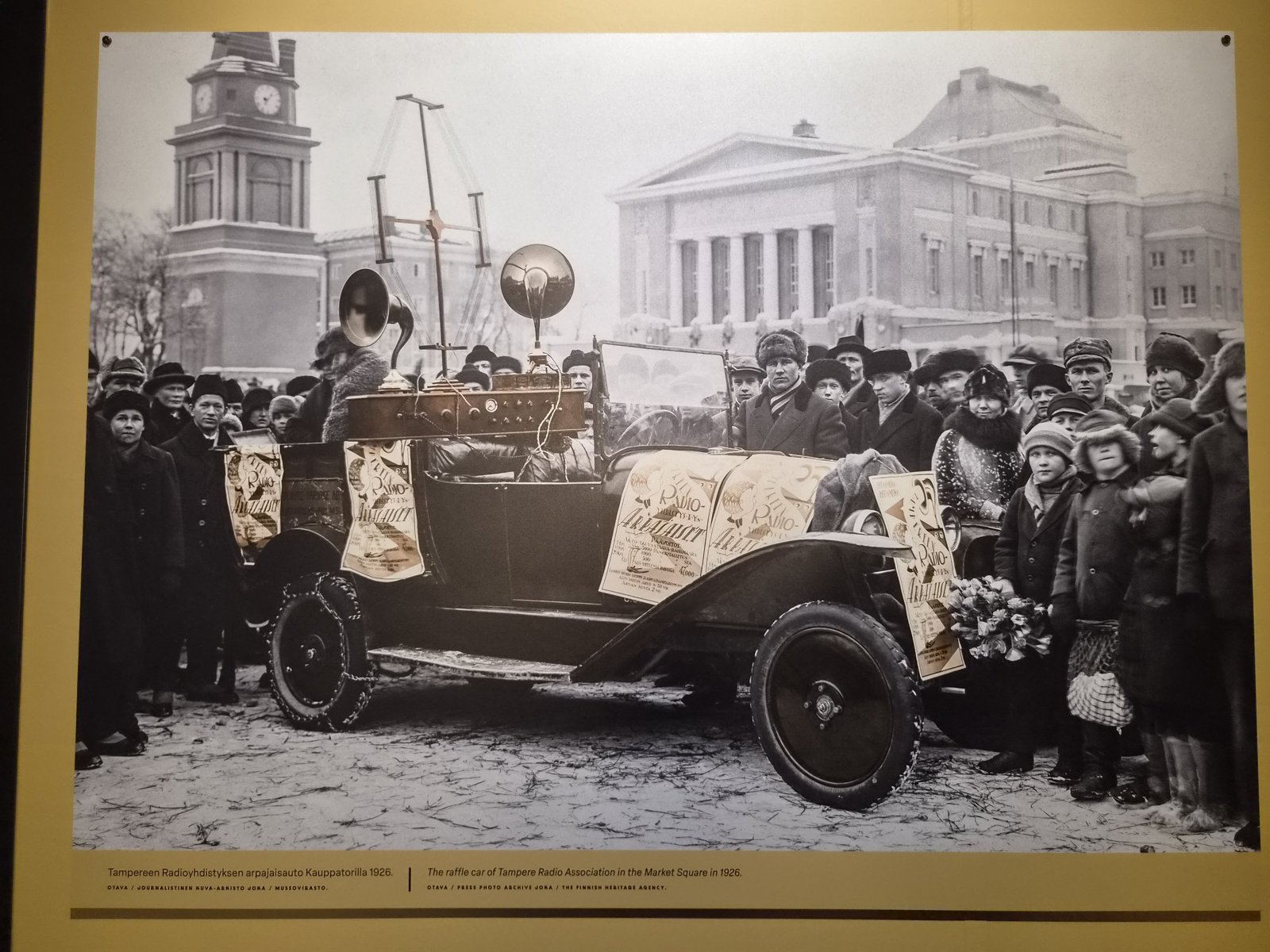
The exhibition opens with a local surprise. The amateur-led station Tampereen Radio began broadcasting regularly on 1 November 1923 and is considered the first public broadcasting station in Finland. It kept going until the state-owned broadcaster Yle was founded in 1926.
Everything ran on goodwill. Volunteers sold raffle tickets around the city to fund the station, while local actors, musicians and speakers performed on air without pay. The studio was a modest shed on the banks of the Tammerkoski rapids – but the technology worked, and Tampere’s broadcasts could be heard from the southern Baltic Sea all the way to Lapland. The photo of the raffle car above, surrounded by curious faces in winter coats, is my favourite picture in the whole exhibition.
Reporters, pirates and the battle for free music

Radio soon left the studio. A big print shows reporter Saara Palmgren in 1954, sitting on a wooden bench in a raincoat with a microphone in hand, the outside-broadcast van parked right behind her. After the Second World War, Europe also began shifting to FM broadcasting – ULA in Finnish – and new receivers came onto the market in the 1950s, among them the Helvar Concertino, one of the first FM radios made in Finland.
Then came the rebels. The era of Nordic pirate radio began in 1958, when commercial programmes were beamed from ships in international waters, beyond national licensing rules. In Finland reception was patchy, but persistent listeners tuned in to stations like Radio Nord near Stockholm, whose pop-filled shows became serious competition for Yle among young people. In the 1970s and 80s, Finnish enthusiasts built land-based pirate stations with home-made equipment under the banner of the Fight for Free Radio movement – and many of them later became radio professionals at Yle or commercial stations.
One quieter panel moved me: radio’s importance for visually impaired listeners. Yle offered free receiving licences to blind people, radio let those who could not attend church follow the services, and today the Finnish Federation of the Visually Impaired runs the online radio Nyöri, made by and for young people with visual impairment.
Commercial radio takes off: helicopters, cassettes and studio desks

Local commercial radio arrived in Finland in the 1980s, and it was loud about it – literally flying its frequency, 96.2 MHz, on the side of a helicopter in 1987. Nearby, two studio photos from the 1990s show the craft of the job: mixing desks, stacks of CDs and walls of labelled cartridges with jingles and ads.


My favourite nerdy detail: in the 1980s you could download software from the radio. Radio 957’s programme Mikrot ULAlla (“Microcomputers in FM”) broadcast buzzing, screeching noises that listeners recorded on cassette at home – and a home computer such as the Commodore 64 decoded the sounds back into program code. The Commodore on display was used on the programme from its very first episode.

And of course, a Finnish radio story isn’t complete without Nokia. A small pink-and-black phone is tuned to 95.00 MHz, next to a curvy white media phone whose Visual Radio app showed song information on screen while you listened to the built-in FM radio. Today, as the final panel puts it, the village’s single radio no longer brings neighbours together – we all carry personal media devices in our pockets. There’s even a small podcast studio where you can record your own audio.
Next door: the Finnish Museum of Games
From radio it’s only a few steps into the Finnish Museum of Games, where Finland’s gaming history starts surprisingly early. The Salora Playmaster, Finland’s first game console, looks like an ordinary TV set but hides a simple sports game built on the same kind of single chip that powered Pong. The chess game Chesmac, written by Raimo Suonio as a hobby project for the Finnish Telmac kit computer, is one of the first commercially published computer games in Finland – it was sold by a Helsinki computer shop and found 104 buyers in total.

For me the stars were the Moomins. Muumit ja Taikurin hattu (“Moomins and the Magician’s Hat”, 1997) combines the books and the early-1990s TV series in a hand-drawn adventure: the characters are voiced by the actors from Tales from Moominvalley, and the story continues Tove Jansson’s Finn Family Moomintroll as you help the Magician reassemble the King’s Ruby.

Right next to it, with a real keyboard and mouse, is Muumipappa kalassa (“Moominpappa goes fishing”, 2001), an early Flash browser game by RedLynx. Moominpappa has a few minutes to catch fish in the pond, and Moominmamma cooks dishes based on your catch. It was a favourite on Sonera’s web portal for nearly a decade – I may have stayed for “just one more round” more than once.
Tips for your visit
- Where: Museum Centre Vapriikki, Alaverstaanraitti 5, Tampere – the radio exhibition is on the 2nd floor, and the Finnish Museum of Games is in the same building.
- Hurry: Riding the radio waves is open until 15 November 2026.
- Hours & tickets (autumn 2026): Tue–Sun 10–18, closed Mondays; adult ticket €16, Museum Card accepted. Free entry on Fridays 15–18 (a few special exhibitions excluded). Check vapriikki.fi before you go.
- For everyone: the radio exhibition has audio guidance in simplified language and audio descriptions for visually impaired visitors.
More from Tampere
Plan your trip to Tampere
A few things that make a museum trip to Tampere easier:
- Stay online: get a Finland eSIM from Airalo before you land – handy for maps and museum tickets on your phone.
- Things to do in Finland: book tours, saunas and city experiences on Klook.
- Where to stay: search hotels and flights to Tampere with the box below.
© Mythstrip. All photos in this post were taken by me at Vapriikki. Archive pictures shown in the exhibition belong to their original photographers and archives, as credited in the captions. Please do not copy, reproduce or reuse the photos or text in any form without written permission.
Leave a Reply