On 30 April 2025, exactly fifty years after the war ended, Netflix released Turning Point: The Vietnam War. The question it left me with wasn’t only about 1975. It was this: half a century on, where does Vietnam stand among the powers that once shaped that war?
What the series covers
It’s a five-episode docuseries by American director Brian Knappenberger, the third in his “Turning Point” series after The Bomb and the Cold War and 9/11 and the War on Terror. It runs from the Gulf of Tonkin incident in 1964 to the fall of Saigon in 1975, drawing on CBS News archives, White House tapes, declassified records and interviews with US veterans, North Vietnamese veterans, former guerrillas, war correspondents such as Peter Arnett and Dan Rather, and novelist Viet Thanh Nguyen.
- Ep. 1 – America Goes to War: Cold War tensions escalate, the US secretly enters the fight, and protests shake South Vietnam.
- Ep. 2 – Civil War: soldiers from both sides recall the war’s origins across the 17th parallel; the US civil rights movement.
- Ep. 3 – Life Is Cheap and Ep. 4 – Why Are We Even Here?: the Tet Offensive shatters the idea that victory is near; witnesses recall the Mỹ Lai massacre.
- Ep. 5 – The End of the Road: Nixon and Kissinger’s secret bombing, veterans speaking out, the Kent State shootings and the fall of Saigon. It closes by saying history repeats itself in Iraq and Afghanistan.
Timeline: from World War II to 30 April 1975
The series starts in 1964, but the war’s roots lie in World War II, the fight against the fascist Axis. Here are the key moments in order.
1940–1945: Imperial Japan and the great famine
From 1940, Japan, an Axis partner of Nazi Germany and Italy, occupied Indochina while the Vichy French administration, itself allied with Germany, stayed in place. The famine of 1944–1945 in the north killed between 400,000 and 2 million people depending on the source; international documents usually estimate around 1 million, roughly 8% of the population (The Diplomat). In March 1945, Japan overthrew the French.
1945: When the US and the Viet Minh were on the same side
Few people know that in the last months of World War II, the US Office of Strategic Services (OSS, the CIA’s forerunner) parachuted an eight-man team, the “Deer Team”, into northern Vietnam to train the Viet Minh against Japan. The Viet Minh supplied intelligence on Japanese forces and rescued downed US airmen; Hồ Chí Minh even had an OSS code name, “Lucius”. On 2 September 1945, with OSS officers watching, he read Vietnam’s Declaration of Independence in Ba Đình Square, opening with a quote from the US Declaration of Independence.
March – August 1945: a power vacuum. On 9 March, Japan overthrew the French. On 11 March, Bảo Đại declared independence and set up the Japanese-backed Empire of Vietnam. On 17 April, Trần Trọng Kim’s government was formed. On 15 August, Japan surrendered after two atomic bombs and a Soviet offensive. Trần Trọng Kim’s government lost its backing before the Allies arrived, and the Viet Minh seized the moment in the August Revolution.
30 August 1945: Emperor Bảo Đại abdicates. Three days before the Declaration of Independence, at the Ngọ Môn gate of Huế’s citadel and before tens of thousands of people, Emperor Bảo Đại read his abdication edict and handed the gold seal and jewel-studded sword to the provisional government’s delegation of Trần Huy Liệu, Nguyễn Lương Bằng and Cù Huy Cận (Báo Văn hóa, Vietnam National Museum of History). It ended 143 years of Nguyễn rule and the monarchy in Vietnam.

1946–1954: America pays for France’s war
After the war, Washington switched to backing France’s return to Indochina. By 1954 the US was paying about 80% of France’s war costs. On 7 May 1954, the French surrendered at Điện Biên Phủ, and the Geneva Accords that July temporarily divided Vietnam at the 17th parallel.
1953–1956: Land reform
Following China’s model and Chinese advisers, peasants were mobilised to “denounce” landlords. Nguyễn Thị Năm, who had given money and gold to the Viet Minh, was shot in 1953. Historian Edwin Moïse estimates that roughly 5,000 to nearly 15,000 people were executed. In 1956 the party admitted “errors” and launched a Rectification of Errors campaign; Trường Chinh lost his post as General Secretary. Peasants in Quỳnh Lưu rose up and were crushed.
The “Munich lesson” and the domino theory
This is the thread that ties World War II to Vietnam. At Munich in 1938, Britain and France appeased Hitler, and the price was a world war. American presidents drew the lesson: never appease an aggressor. On 7 April 1954, Eisenhower set out the “domino theory”: if one Southeast Asian country fell to communism, the rest would follow. Appealing to Britain to intervene, he recalled how the world had failed to stop Hirohito, Mussolini and Hitler. Lyndon Johnson and Secretary of State Dean Rusk saw Munich as the most important historical lesson of their time, a belief that helped push US troop levels in Vietnam to 500,000 by 1968.

August 1964: Gulf of Tonkin
Episode 1 begins here. Washington reported a second attack on US destroyers; three days later Congress passed the Tonkin Gulf Resolution. In 2005, declassified NSA documents showed the intelligence on that second attack had been skewed.
30–31 January 1968: The Tet Offensive
An attack during a truce. By tradition, both sides paused the fighting for a few days at Tết so families could reunite. In 1968, the North publicly declared a seven-day truce from 27 January to 3 February; the US and South Vietnam declared 36 hours, and more than half of the South’s army went home on leave. During that very truce, North Vietnamese and Viet Cong forces attacked five major cities, 36 provincial capitals, 64 district capitals and many villages across the South (Edwin Moïse, GlobalSecurity). In other words, the offensive opened by breaking the truce the North itself had just announced.
The Huế massacre. Communist forces held Huế for about 25 days. After the city was retaken, dozens of mass graves were found; according to Texas Tech University’s Vietnam Center, at least 3,000 people were killed this way and some 2,000 more went missing. Smithsonian reports that many victims were tied, blindfolded and shot at close range, or buried alive. Some scholars, such as Gareth Porter, questioned the scale, and historian Scott Laderman argues the exact events remain contested; but the mass graves were real.
Casualties from many sides. Civilians died in the Huế executions, in street fighting, and when the US Air Force bombed South Vietnamese cities to drive the attackers out (Moïse). Also in March 1968, US soldiers massacred the villagers of Mỹ Lai, an event the series recounts through witnesses.
Women and teenagers pulled into the war. According to PBS, most Viet Cong recruits were young teenagers; many joined out of idealism, but others were pressured or shamed into joining. In 1968, the New York Times News Service reported that the Viet Cong had stepped up recruiting young women for combat, and captured documents showed they wanted women to make up a third to a half of their guerrilla strength to replace losses. Yet research by Dr Mai Anh Nguyen (SOAS, London), based on interviews with former Viet Cong child soldiers, finds their motivations were complex and cannot be reduced simply to victimhood.
Losing the battle, winning the politics. Militarily, the attackers suffered very heavy losses, some 50,000 killed according to GlobalSecurity. Politically, the shock turned American opinion. On 27 February 1968, Walter Cronkite, America’s most trusted newsman, concluded on CBS that the war was mired in stalemate. Johnson reportedly said that if he’d lost Cronkite, he’d lost middle America. On 31 March 1968, Johnson announced he would not seek re-election.
27 January 1973: The Paris Peace Accords
After years of talks, including secret rounds between Henry Kissinger and Lê Đức Thọ, the Paris Accords were signed with three main terms: a ceasefire, withdrawal of all US and allied forces within 60 days, and the return of prisoners of war. Crucially, the accords did not require North Vietnamese troops already in the South to withdraw. President Thiệu objected because some 150,000 North Vietnamese troops would stay while half a million Americans left; Nixon forced him to sign by threatening to cut off all aid.
Peace never came. The fighting didn’t stop even for an hour after the signing, and both sides violated the ceasefire to grab territory (Encyclopedia.com). In 1973 alone, the North sent another 14,000 troops and 86,000 tons of supplies south (Harvard Rajawali). Meanwhile, the US Congress made deep cuts to aid for Saigon and passed the Case-Church Amendment, barring any new US military involvement in Indochina. China and the Soviet Union also reduced aid in 1973, but the North continued to be armed. Historian Michael Lind argues that the South fell to a Soviet-equipped army.
In early 1975, about two years after Paris, the North launched its general offensive. The original plan ran into 1976, but as the South’s army collapsed, the Politburo sped up, and on the morning of 30 April 1975 tanks rolled into Independence Palace. Kissinger and Lê Đức Thọ had been jointly awarded the 1973 Nobel Peace Prize; Thọ refused it, saying peace had not yet been achieved.


28 April 1975: The bombing of Tân Sơn Nhất
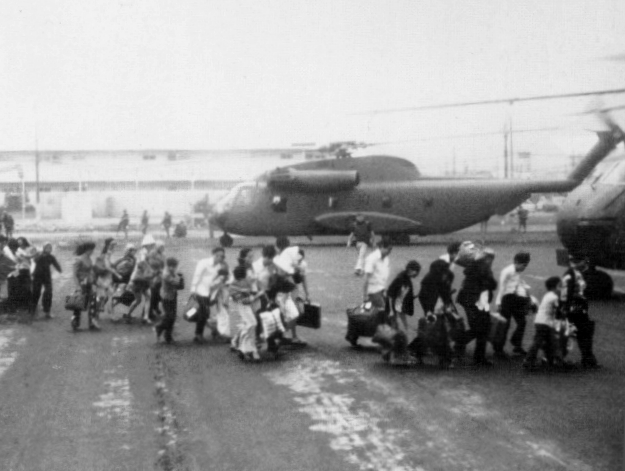
On the afternoon of 28 April 1975, the Quyết Thắng Squadron, five A-37 attack jets recently captured from the South Vietnamese Air Force, took off from Thành Sơn air base (Phan Rang) and bombed Tân Sơn Nhất airport (Nhân Dân). They were led by Nguyễn Thành Trung, a South Vietnamese pilot who had bombed Independence Palace and flown to communist-held territory on 8 April 1975. According to PBS, the raid threw the American evacuation into chaos. The physical damage was relatively minor, but the remnants of the South’s air force fled to Thailand and the fixed-wing evacuation was halted. From then on, helicopters were the last way out, as in the photo below.
You can see Hubert van Es’s original photo and the story behind it at UPI: Last day in Saigon.

29 April 1975: The war’s most famous helicopter photo
The day before Saigon fell, Dutch photographer Hubert van Es (UPI) photographed evacuees climbing a ladder to an Air America helicopter on a rooftop. For decades the photo was mislabelled as the US Embassy. In fact it was 22 Gia Long Street, now 22 Lý Tự Trọng, District 1, a building used by the CIA and USAID. Van Es captioned it correctly, but UPI’s Tokyo office changed the caption to “embassy”, and his attempts to correct it over the years failed. Over those two days, Operation Frequent Wind airlifted more than 7,000 people out of Saigon.


A detail for anyone in Saigon: according to Saigoneer, the elevator housing where the helicopter perched is still there, visible from the upper floors of Vincom Center facing Lý Tự Trọng Street.
30 April 1975 and after
The war ended, but history didn’t follow Cold War straight lines. Just four years later, in 1979, China attacked Vietnam’s northern border. Twenty years after the war, in 1995, Vietnam normalised relations with the United States itself.
The New Economic Zones. After 1975, families of former officers, civil servants and small traders were sent to clear virgin land, much of it malarial. An estimated 750,000 to over 1 million southerners were displaced (Desbarats, 1987). Many families drifted back to the cities or fled by boat. A 1978 CIA assessment found the government pressured people to go but did not move them by force.
Campaigns against capitalists, nationalisation and currency swaps. In late 1975 the new government launched a campaign against the “comprador bourgeoisie” and a first currency reform. On 22 September 1975, southerners had from 11am to 11pm to swap their cash at 500 old South Vietnamese đồng for one “liberation” đồng, and each family could exchange at most 100,000 old đồng. In late March 1978 a second campaign abolished “bourgeois” trade, confiscated private businesses and nationalised factories. Some 30,000 businesses were closed, 80% of them owned by ethnic Chinese in Chợ Lớn and other towns, alongside a nationwide currency unification in May 1978. From April 1978, about 450,000 ethnic Chinese left Vietnam overland to China or by sea. In 1985 a third currency swap (ten old đồng for one new) again capped how much each household could exchange; cash above the limit had to be deposited and was largely lost to the inflation that followed.
The Redemptorists of Huế. According to the Vietnamese Redemptorists, in 1930 the order bought at auction a 20,433.5 m² plot on Khải Định (now Nguyễn Huệ) Street, and on 10 July 1971 Huế’s city hall confirmed its ownership. According to The Vietnamese, on 1 September 2025 Huế authorities fenced off the L’Accueil part of the land at 87 Nguyễn Huệ; the order called it an unlawful appropriation. Local Catholics say the site once sheltered Empress Nam Phương in 1946 and people of every faith during Tet 1968. On 17–18 November 2026, police blocked the surrounding streets, cut power to the church and forcibly demolished the L’Accueil building, working through the night.


Similar strategies: from the Viet Cong to later insurgencies
The previous series in the franchise, “Turning Point: 9/11 and the War on Terror”, covers America’s war against Islamist extremism. Side by side, military analysts see tactics repeating, even though the goals and ideologies of the groups involved are very different.
Guerrilla war and time: the Viet Cong and the Taliban
According to Small Wars Journal, the Taliban resembled the Viet Cong in many ways: decentralised fighting groups, a shadow political leadership, and using the terrain to blunt US technological superiority. Both followed Mao’s model of guerrilla war, moving between phases as conditions required. The saying often attributed to the Taliban, “you have the watches, we have the time”, captures the same strategy: drag the war out until the outsider tires and goes home.
Tunnel warfare: Củ Chi and Gaza
The Củ Chi tunnels, about 35 km from Saigon, were a network hundreds of kilometres long, with sleeping quarters, weapons stores and command rooms that let guerrillas strike and vanish underground. Củ Chi forces played a key role in the Tet Offensive (CBC). As Israel fought Hamas, Foreign Policy ran a piece by a retired US Army colonel arguing that Hamas’s tunnel warfare harks back to the Viet Cong. In 2016, Hamas leader Ismail Haniyeh claimed Gaza’s tunnel network was twice the size of Củ Chi.
Hamas in the Gaza Strip. Hamas, which controls the Palestinian Gaza Strip, is designated a terrorist organisation by the United States, the European Union, the United Kingdom and others such as Canada, Australia and Japan. On 7 October 2023, Hamas attacked Israel, killing some 1,200 people, mostly civilians, and taking 251 hostages into Gaza; the remains of the last hostage were returned only on 26 January 2026. Israel, the EU and the UN Secretary-General have accused Hamas of using civilians and hospitals as human shields; Hamas denies it, and in earlier wars Amnesty International found no evidence for the claim. The war has also killed more than 67,600 Palestinians in Gaza, mostly women and children, according to the Gaza Health Ministry.
Riots in Europe and the Palestinian flag. From the weekend of 17 October 2026, riots with looting, arson and attacks broke out in France, Italy and Belgium. Limoges City Hall was badly damaged by arson; France alone saw more than 2,000 arrests and over 600 police, gendarmes and firefighters injured. Palestinian flags were everywhere: protesters waving them stormed the Colosseum in Rome and shops were looted in Barcelona, and a Paris synagogue was ransacked and Jewish-owned shops in Marseille were set on fire amid chants of “Intifada”. In my view, the presence of Palestinian flags at almost every riot shows that the main aim was to stir up unrest over Palestine, and that the other reasons were only a pretext. Earlier, in November 2024 in Amsterdam, fans of the Israeli club Maccabi Tel Aviv were hit in “hit-and-run” attacks after a match, leaving five briefly hospitalised; Dutch authorities called it antisemitic violence.
Iran and the “Axis of Resistance”. The Islamic Republic of Iran has been on the US list of state sponsors of terrorism since 1984. According to the US State Department, Iran provides most of Hezbollah’s funding, weapons and training, up to $100 million a year to Hamas and other Palestinian armed groups, and missiles and drones to Yemen’s Houthis. The network calls itself the “Axis of Resistance”, and its shared aims include expelling the US from the Middle East and destroying the State of Israel. Iran’s Islamic Revolutionary Guard Corps (IRGC) is designated a terrorist organisation by the US, Canada, Australia and the European Union (January 2026). In Europe itself, a Belgian court in 2021 sentenced Iranian diplomat Assadollah Assadi to 20 years for bringing explosives from Iran to bomb an Iranian opposition rally near Paris in 2018; the court found he ran a state intelligence network. In October 2026, the head of Britain’s MI5 said Iran was targeting military bases in the UK and that more than 50 people had been arrested over Iran-linked plots in a single year. During the Paris riots, images on social media showed rioters flying both Palestinian and Iranian flags. Tehran denies all accusations of such plots.
Countries that ban fascism, communism and Islamist extremism. Germany and Austria strictly ban Nazi propaganda and symbols; France, Italy, Poland, Czechia, Hungary, the Baltic states, Israel, Brazil and Australia (since 2024) have similar laws (list). Promoting communism is a crime in Indonesia (since 1966), South Korea, Ukraine (since 2015, up to five years in prison), Poland and Czechia; Lithuania and Latvia ban public display of Soviet symbols (list). For Islamist extremism, countries usually ban specific groups: Hizb ut-Tahrir, which seeks a global “Caliphate”, is banned in Germany, Egypt, Jordan, Saudi Arabia, Turkey, Pakistan, Bangladesh and the UK (January 2024); the Muslim Brotherhood is banned in Egypt (2013), Saudi Arabia, the UAE, Bahrain and Jordan (April 2025), and the US designated its Egyptian, Jordanian and Lebanese branches as terrorist groups (January 2026). Austria has banned Muslim Brotherhood, Hamas and Hezbollah symbols since 2019.
A Soviet flag at a football match. According to the AFC Disciplinary and Ethics Committee’s decisions of 19 November 2026, Cong An Ha Noi FC was fined US$2,000 under Article 65.1 because its fans displayed a Soviet Union flag in the stands at its away match against Gamba Osaka in Japan (15 September, AFC Champions League Elite). This is an AFC rule that holds clubs responsible for their fans, not a Japanese law.
50 years on: signs of a tilt toward China, Russia and North Korea

China: railways, joint patrols and a first army drill
- In April 2025, Xi Jinping visited Hanoi and the two sides signed 45 agreements covering supply chains, AI, joint maritime patrols and railways (Reuters, RTHK). China then offered loans, technology and Chinese contractors for Vietnam’s railway projects.
- In July 2025, the two armies held their first-ever joint army exercise, in Guangxi, the region that served as the staging area for China’s 1979 invasion (Carnegie).
- Carnegie also notes that Vietnam’s 2018 Cybersecurity Law mirrors Chinese legislation, and that senior Public Security delegations regularly visit China to study surveillance and political-control methods, ties the author calls far deeper than occasional drills.
- Economically, Vietnam imported US$186 billion of goods from China in 2025, with a trade deficit of US$115.6 billion, up almost 40%.
Russia: Putin in Hanoi, Vietnamese troops on Red Square
- In June 2024, Putin flew to Hanoi straight from Pyongyang, where he had just signed a mutual defence pact with North Korea. None of the 12 announced agreements were openly about defence, but Vietnam said other deals were not made public (AP). The US Embassy criticised the visit.
- On 9 May 2025, 68 Vietnamese soldiers marched in Moscow’s parade marking victory over fascism, with Party chief Tô Lâm watching: the first time the Vietnam People’s Army officially joined a parade abroad.
- On 2 September 2025, Chinese and Russian troops marched alongside Vietnamese forces in Hanoi (AFP/RTHK). The Diplomat noted that the Chinese contingent came first, then Russia, Laos and Cambodia, mirroring the hierarchy of Vietnam’s foreign relations.
The Soviet collapse (December 1991). After the failed coup of August 1991, the leaders of Russia, Ukraine and Belarus signed the Belavezha Accords on 8 December 1991, dissolving the Soviet Union; Gorbachev resigned on 25 December. The 15 republics became 15 independent states. Having lost its biggest backer, Vietnam normalised relations with China in November 1991 and with the US in 1995. Throughout the Cold War, Finland stayed neutral to keep its independence next to the Soviet Union (“Finlandisation”). See the map of the 15 republics and the “Nordic Balance” in The Fall of the Soviet Union in December 1991.
The Russia–Ukraine war and EU sanctions. In November 2026, Russia, Ukraine and the US held talks in Abu Dhabi, but there is still no ceasefire. According to ISW, Russia still demands that Ukraine hand over the rest of Luhansk, Donetsk, Zaporizhia and Kherson. Meanwhile, the EU adopted its 20th sanctions package (April 2026) and 21st package (July 2026), targeting Russian oil, the “shadow fleet”, banks and crypto, then listed almost 1,600 more people and companies in Russia’s defence industry. Around €210 billion of Russian central bank assets remain frozen; the EU is lending Ukraine €90 billion for 2026–2027, to be repaid only once Russia pays war reparations. Moscow calls the sanctions illegal.
North Korea: the first top-level visit in almost 20 years
In October 2025, Tô Lâm visited Pyongyang, the first trip by Vietnam’s party chief in almost two decades, timed with the parade for the Workers’ Party’s 80th anniversary. But according to Rane/Stratfor, Hanoi issued a statement beforehand to head off any impression that it supported North Korea’s weapons programmes. The two countries have virtually no trade.
Sources
- Netflix: Turning Point: The Vietnam War · episode guide · Salon · Mark Moyar
- The Diplomat: the 1945 famine · National WWII Museum: The OSS in Vietnam, 1945 · Military.com: the Deer Team
- Britannica: the US and the First Indochina War · US State Department: Dien Bien Phu
- The Munich analogy and the Vietnam War · Edwin Moïse: The Domino Theory · Moïse: Tonkin Gulf
- Texas Tech Vietnam Center: Tet · Cronkite, 27 Feb 1968
- Paris Peace Accords · UPI Archives 1973
- 22 Gia Long Street · Saigoneer: The Story of a Famous Photograph · BBC
- Small Wars Journal: Vietnam and Afghanistan · Brenthurst Foundation
- Foreign Policy: Hamas’s tunnel warfare · CBC: From Vietnam to Gaza · Paul Pillar on Tet
- Reuters: Xi in Hanoi · RTHK · Carnegie
- AP/NPR: Putin in Hanoi · AFP/RTHK: 2 September parade · The Diplomat
- The Star: Tô Lâm in North Korea · Rane/Stratfor
- AMTI/CSIS · 2025 trade figures · University of Navarra · East Asia Forum
More sources: Edwin Moïse on Tet · GlobalSecurity: Tet · Texas Tech: Huế 1968 · Smithsonian · Scott Laderman · PBS: Battlefield Vietnam · NYT News Service, 1968 · Mai Anh Nguyen (SOAS) · Harvard Rajawali: legacy of the Paris Accords · Encyclopedia.com: 1973–75 · Kissinger, Ford and Congress · The Diplomat: the 1979 war and textbooks · West Point: Vietnamese textbooks 1975–2000 · James Loewen: US textbooks
On 1945, land reform, the New Economic Zones and the Huế Redemptorists: Empire of Vietnam · Alex-Thai D. Vo (Journal of Vietnamese Studies, 2015) · Edwin Moïse: Land Reform in China and North Vietnam · New Economic Zones program (citing Desbarats 1987) · CIA (1978) · The Vietnamese (Sept 2025) · Vietnamese Redemptorists (17 Nov 2026, Vietnamese)
Leave a Reply