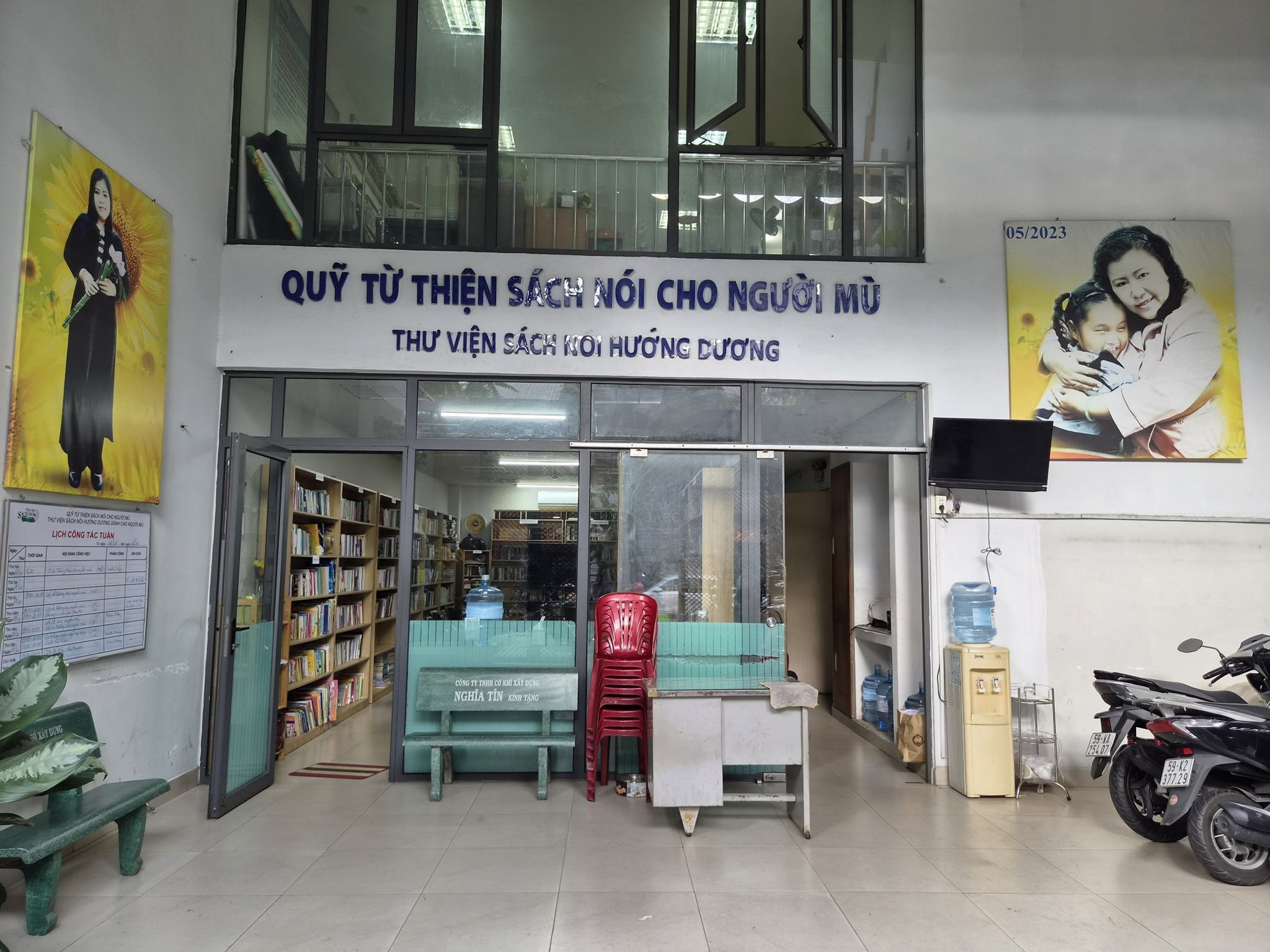

On Thursday afternoon, 19 November 2026, I visited the Hướng Dương Audiobook Library for the Blind (Thư viện sách nói Hướng Dương dành cho người mù) in Tân Định ward, Ho Chi Minh City. From the outside it is a modest ground floor: wooden bookshelves, a water cooler, a few motorbikes parked by the wall. Behind the glass door, though, thousands of books have been read aloud so that people who cannot see the page can still read with their ears.
The library opened in May 1998 and is recognised as Vietnam’s first audiobook library for blind people. Today it runs under the Charity Fund of Audiobooks for the Blind, supported by donors and a large team of volunteers.
The woman named after a sunflower
The first thing you see inside is a white stone statue of Nguyễn Hướng Dương (1971–2018), the founder. “Hướng Dương” means sunflower. The statue shows her in an áo dài, holding a bouquet, surrounded by pots of bright yellow sunflowers.

At 25, she lost both legs in a traffic accident. The idea for audiobooks came almost by chance: reading aloud to students at Nguyễn Đình Chiểu School for the blind, she noticed how much they loved listening to her voice. She went on to record books herself while raising money for the library, and later set up the Hướng Dương and Ánh Sen scholarships for visually impaired students. She died in an accident in April 2018, aged 47.

Her memorial corner is titled “Một đóa hoa sáng ngời” – A Shining Flower. The photos tell her story: in her wheelchair receiving flowers, reading in front of a microphone, hugging a blind little girl, on stage launching a computer course for the blind, at the third chess tournament for blind players in 2013. Underneath runs a line celebrating 20 years of the library, 1998–2018.

It started with one old recorder
In the glass cabinet below, among poetry books, cassette tapes, CDs and a yellow T-shirt, one object kept me there a long time: the library’s very first audiobook recorder. A small card explains that from 1998 to 2003, Hướng Dương read the books and operated the machine herself. No studio, no sound engineer, just one voice and one machine.

From that machine came thousands of audiobook titles: literature, history, science, life skills, medicine, and school textbooks from primary level to university for blind students. A certificate on the wall from the Vietnam Records Book Center confirms it as the country’s first audiobook library for the blind.

The volunteer voices
The heart of the library is a small recording booth lined with yellow acoustic foam, its shelves full of stuffed toys and piles of books labelled with each reader’s name. When I visited, Lê Như Quỳnh, a long-time volunteer, was sitting at the microphone, turning the pages of a school textbook. She brings the voice of a TV news presenter to every page: slow, clear and warm. The library now has more than 100 Vietnamese and foreign volunteers who read, proofread, summarise books and handle communications. There is even a waiting list of people hoping to pass the voice test and get a recording slot.

One framed photo I loved shows the volunteer readers’ year-end party: dozens of people of every age, including a little girl flashing a V sign. Many of them had never met before. What they share is the habit of lending their voices to strangers.

More than audiobooks
Walking around, I realised the library does far more than record books. There is a computer room for IT and smartphone classes for blind people, and a chess room with a training programme for visually impaired players. One photo from 2012 shows blind chess master Nguyễn Mạnh Hùng, blindfolded, beating Associate Professor Nguyễn Thiện Tống 1–0. Another shows the medal ceremony of a 2011 chess tournament for the blind.


In the corridor stands a banner for the “White canes for the blind” programme, with the fund’s bank details for anyone who wants to donate. Further in, the reading room is lined with printed books: foreign literature, general titles, dictionaries, newspapers and magazines, all waiting to be given a voice.

A wall of recognition
The last wall is covered in honours: a certificate of merit from the Prime Minister, a commemorative medal for contributions to education, the “For the Happiness of the Blind” medal from the Vietnam Blind Association, and a photo of Hướng Dương in her wheelchair receiving the Second-Class Labour Order in 2010. In the middle of all those gilded frames hangs a children’s clay painting of a rainbow, a gift from “Nhật Hồng”. I suspect that was her favourite.

Leaving the library, I kept thinking about that old recorder. A woman in a wheelchair read and pressed the buttons herself for five years, and almost three decades later, people still sit down at the microphone every day to read in her place.
Visiting and how to help
- Address: Hướng Dương Audiobook Library for the Blind, 18B Đinh Tiên Hoàng, Tân Định ward, Ho Chi Minh City (map)
- How to help: volunteer as a reader, proofreader or summariser (Vietnamese and foreign volunteers are welcome); support the white cane programme; donate to the Charity Fund of Audiobooks for the Blind (bank details are on the banner at the library).
- Tips: the weekly schedule is posted on a board by the entrance; contact the library ahead for group visits, and keep quiet near the recording booth.
- Further reading (Vietnamese): Sài Gòn Giải Phóng newspaper on the library’s recent work.
More from Vietnam
© Mythstrip. Photos taken by me at the Hướng Dương Audiobook Library on 19 November 2026; the framed archive photos belong to the library. Please do not reuse photos or text without permission.
In Saigon? Try a handicraft workshop at Myths Cafe or a phở cooking class with Myths Trip.
Leave a Reply