The rise of nationalism and separatism
The Soviet Union was a federal state of 15 republics and more than 100 ethnic groups. As central power weakened under Gorbachev, nationalism surged.
- The domino effect from Eastern Europe (1989): Gorbachev abandoned the “Brezhnev Doctrine” (using force to keep allied states in line). Socialist governments across Eastern Europe fell one after another, and so did the Berlin Wall. This directly encouraged independence movements inside the Soviet Union.
- The “parade of sovereignties” (1990–1991): The Baltic republics (Lithuania, Latvia, Estonia) led the way by declaring independence. Most strikingly, the Russian Soviet Federative Socialist Republic (RSFSR) itself, led by Boris Yeltsin, declared sovereignty and put Russian law above Soviet law, paralysing Gorbachev’s central government.
December 1991: the Soviet Union dissolves
After the failed coup of August 1991, the Soviet Communist Party was suspended and real power passed to the leaders of the republics. On 8 December 1991, the leaders of Russia, Ukraine and Belarus signed the Belavezha Accords, declaring the Soviet Union dissolved and founding the Commonwealth of Independent States (CIS). On 25 December 1991, Gorbachev resigned, formally ending the Soviet Union’s 69 years.
The “Nordic Balance” during the Cold War
Throughout the Cold War, the Nordic region was a strategic buffer between NATO and the Soviet Union, giving rise to the idea of a “Nordic Balance”:
- Finland: To keep its independence and avoid being annexed like the three Baltic states (Estonia, Latvia, Lithuania), Finland signed a friendship treaty with the Soviet Union in 1948, committing to neutrality, staying out of NATO and avoiding foreign policies aimed against Moscow. Political commentators called this “Finlandisation”.
- Sweden: Kept a strict policy of armed neutrality throughout the Cold War to help keep the region stable.
- Norway, Denmark and Iceland: All three were founding members of NATO (1949). Norway and Denmark set themselves voluntary limits: no nuclear weapons and no permanent foreign military bases on their soil in peacetime, so as not to provoke the Soviet Union. Iceland has no army of its own and hosted the US base at Keflavík from 1951 to 2006.
→ Read more about Finnish–Russian relations at the Nootti Museum, Tampere (Part 3).
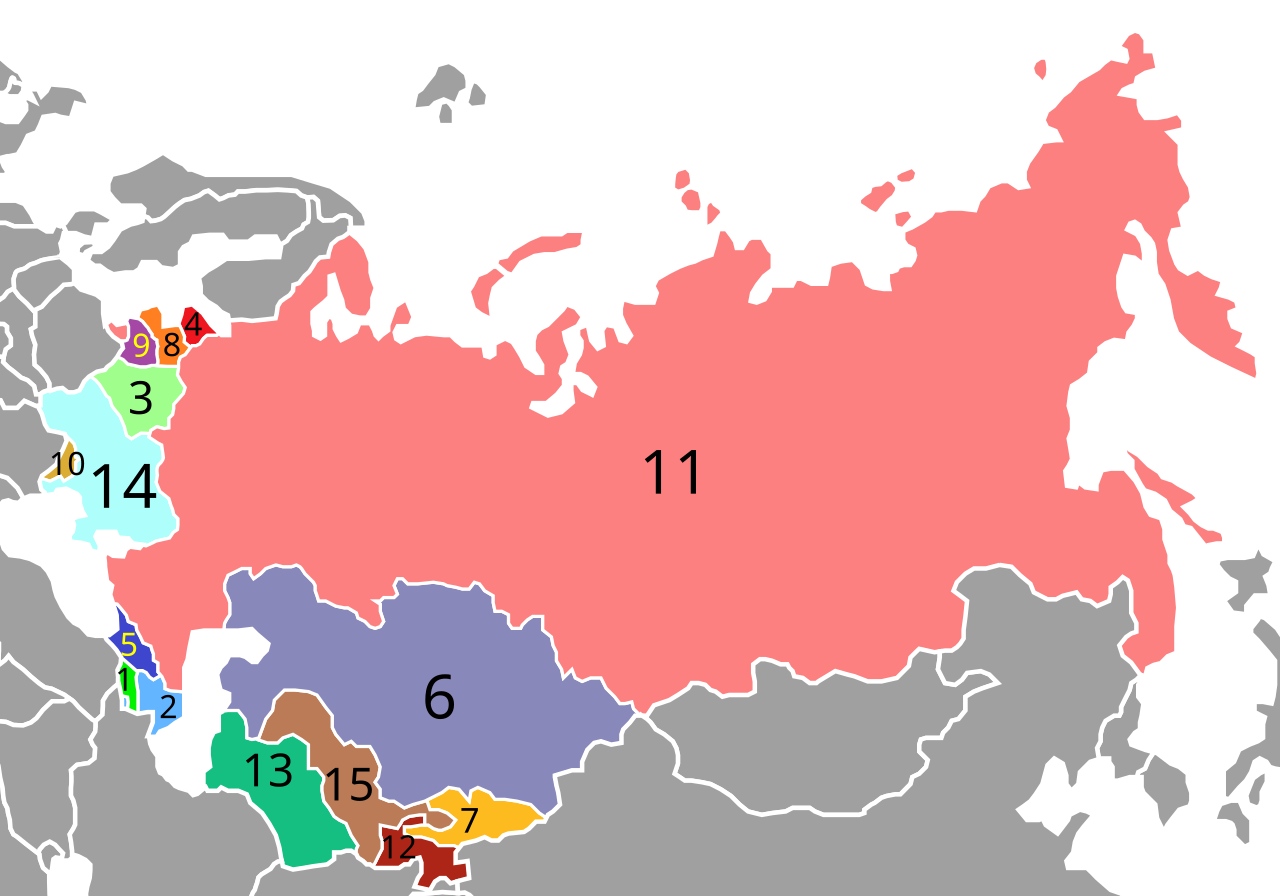
The 15 republics on the map

Using the numbers on the map, the 15 republics fall into these main regions:
- Russia (the central pillar): 11. Russian SFSR (more than 75% of the Soviet Union’s territory)
- Eastern Europe: 3. Byelorussia (today’s Belarus) · 10. Moldavia (today’s Moldova) · 14. Ukraine
- The Baltics (first to seek independence): 4. Estonia · 8. Latvia · 9. Lithuania
- Transcaucasia: 1. Armenia · 2. Azerbaijan · 5. Georgia
- Central Asia: 6. Kazakhstan · 7. Kirghizia (today’s Kyrgyzstan) · 12. Tajikistan · 13. Turkmenia (today’s Turkmenistan) · 15. Uzbekistan
When the Soviet Union collapsed at the end of 1991, all 15 numbered republics on this map became the 15 sovereign states we know today.
Leave a Reply